Ranking Nonhuman Intelligences
From The Children of Time Universe
(*with pokemon for visual aid)
A review by Jonathan Wojcik
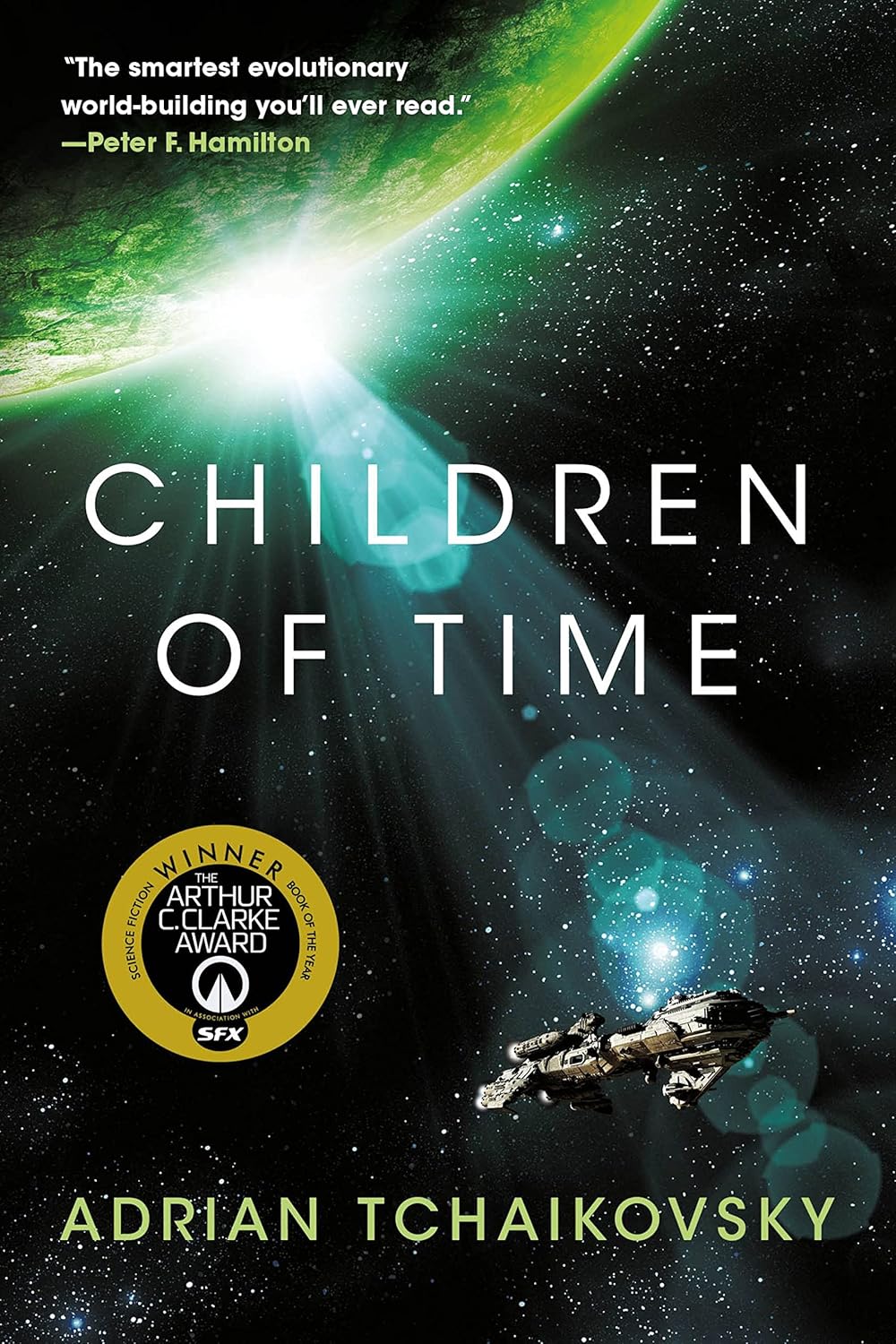
In Adrian Tchaikovsky's 2015 novel Children of Time, humanity has long ago achieved many of its technological dreams. We can travel between solar systems, we can sleep indefinitely, we can upload self-aware copies of our minds, we can engineer new species and we can even, in theory, bring life to lifeless planets. None of this, however, stops our great Empire from eventually collapsing in on itself, leaving a galaxy littered with dead or dying colonies and forgotten, half-terraformed worlds.
Worse yet, in all the thousands of years we had apparently spent exploring the stars, that collapse came before we ever found anything at all resembling intelligent, extraterrestrial life, our interplanetary utopia rising and falling unnoticed by anything else in the quiet, lonely vastness of explored space.
...But just what the hell is intelligence, anyway? Where does it begin and end? What are its minimum requirements? And when does it begin to have the value we culturally ascribe to it? These are the questions explores in rich detail over the course of the first three books, but I've yet to start reading the fourth in the series, released the same year that I'm writing this post. Drawing from just those first three for the time being, I'm going to overshare about their non-human intelligences not in order of my "favorites," per se, which would be impossible to sort out, but in just how creatively they deviate from "human" intelligence as we know it...and yeah, with pokemon for visual reference.
#5: THE PORTIIDS
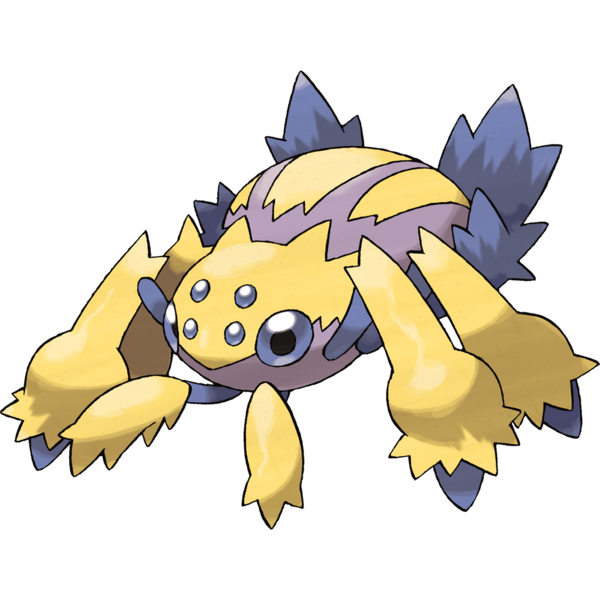
By the start of the first book, much of Earth's remaining human populace are already frozen on a number of Ark Ships, hoping to find anywhere still livable in the decaying traces of the empire. As they'll eventually learn, there's only one distant planet in their path where life has boomed; a terraforming effort still monitored from orbit by the digitized mind of a just slightly egomaniacal scientist, Avrana Kern, who has already spent eons tracking what she believes to be the progress of the monkeys she infected with her own original, human-derived hyper-evolution virus.
But we, the reader, already know that her monkeys quickly went extinct, and that her virus jumped ship long ago to multiple arthropods - such as a species of jumping spider in the already quite clever Portia genus. While our human characters artificially live for millenia, in and out of "sleep," we follow generation after generation of arachnid cultural development, stages of their scientific enlightenment and a roller coaster of new twists following their first contact with the "goddess" beyond their sky. You know it's coming from the beginning, but I still don't dare spoil the specifics of how Kern and the Spiders finally discover the truth about one another, how they respond to those revelations, and how they finally deal with the threat of human colonists who are not at all prepared to share a planet with cat-sized venomous "pests."
Having developed under the influence of what is essentially "infectious humanity," the Salticid mentality isn't nearly as far from our own as it might have been under natural evolution. Their boundless curiosity, philosophical imagination and insatiable need to create drives their societal evolution in leaps and bounds just like our own, even if they do make it from spider stone age to spider space age in a microfraction of the time. But Kern's virus was intended to uplift our fellow primates, and the Portiids are alien by as many of our standards as they are familiar. Their Vulcan-like preference for logic and their lack of anything we might easily recognize as "love" would have branded them as ruthless villains in so many other narratives, but they do eveeentually decide that their smaller, weaker males deserve the same fundamental rights as females, and they do eveeeeentually decide that mate cannibalism should be a social taboo and finally an actual crime, no matter how badly a male might completely botch a courtship dance.
There are many fascinating nuances to how these earth-born-aliens are characterized, but they're at the "bottom" of my "ranking" because they ultimately have the most humanlike minds on our list, which of course is the whole point of their story arc, and a truly wonderful role for spiders to be given in any story at all. In a perfect timeline, this is a setting with its own long-running, big-budget space opera series to rival Star Trek.
#4: THE "CROWNS"

In Children of Ruin, we learn how a lineage of artificially enhanced Cephalopods came to be abandoned on a planet entirely covered by ocean, and by the time the book begins, they've already perfected their own enormous, water-filled space vessels. Unfortunately, stark communication barriers pose complicated, life-or-death obstacles to their emerging contact with a certain starfaring collective of air-breathers...further compounded by an outbreak of a mysterious, incurable and deadly infection from beyond we'll have to talk about in just a moment.
Not virally forced to mirror human brain patterns, the mollusks have a far more abstract mindset than the other eight-limbed invertebrate-folk we've long grown accustomed to. You may know that the nervous system of a real octopus supposedly allows its limbs to act almost autonomously of active input, each arm capable of independently exploring its surroundings until it finds something that catches the attention of the rest of the animal. Granted, your own body is constantly doing all sorts of things and registring all sorts of information that you don't have to think about, and can even alert you to something it "noticed" before "you" did, but it's not generally so sophisticated that you can confidently rely on your hands and feet to safely drive a car while you space off and daydream for hours.
Not only is that what this kind of octopus can do, but that's seemingly even how its kind invented their equivalent to a car. And it's how they build their architecture. And produce their art and literature. And it's especially how an enlightened space-octopus prefers to socialize, because there's nothing the conscious part of it, or what it calls its "crown" dislikes quite as much as all other octopuses, so it's a good thing the collective effort of its arms, or "reach", can handle all that business of holding a civilization together while it's free to disassociate as soon as it gets either bored or annoyed, which is very, very often.
It's a lot like living your entire life tethered to eight personal ai-powered roombas that can do all your other household chores, your taxes and your cooking and your phone calls while you just sort of nudge them back in the right direction should they start to veer off-course. As a result, the octopod's "crown" mentality has little need to maintain steady focus on any single thought process, and its attention span has consequently gone the way of a kiwi bird's wings, or the eyeballs of an olm. Their amorphous minds ricochet from one train of thought to another so rapidly, everything from their current emotional state to their entire life's goals can shift in any conceivable direction, at literally any moment, for no evident external reason, and they all just sort of accept this as the natural way. It's apparently not unusual at all for an octopus to completely change sides in even their most divisive ideological debates, multiple times, within the same conversation, and their culture is a maelstrom of artistic fads and trends that can come and go in a flash. It's as if their entire way of thinking and entire society is prone to "changing color" as spectacularly as their own skins!
#3: "THESE OF WE"

The other side of Children of Ruin deals with what should have been the greatest discovery in human history, but was unfortunately just sort of filed away and overlooked in the aftermath of our collapse: one single planet that actually evolved its own native ecosystem of macroscopic alien life. Most of the few humans aware of their existence see only a new bundle of resources to exploit, but hiding beneath the surface is something terrifying. At least, at first.
"These of we," as they refer to themselves, are microscopic amoeboids that live only fleetingly as individuals, but can connect to one another in a self-aware colonial network with a memory so flawless and limitless in capacity, they just think of it as making "record" of everything they encounter. Living harmlessly in the tissues of larger organisms, they can more or less perform the functions of a "brain" as necessary for their planet's otherwise near-mindless wildlife, or what they of course regard as vessels. The exploration and understanding of these vessels is the only grand pursuit they know, spending eons idly contemplating the innards of sluggish, starfish-like grazers and membranous sky-fish. It's all terribly exciting to them, of course, because a single host may as well be an "entire world" of biochemical phenomenon to observe, and their single planet, at their scale, is still a largely unexplored outer "universe."
So, one day a few of these little pioneers discover the unthinkable: an alien world from beyond the universe, and one with "lightning" in its cells that they soon decipher as thought. This first contact is a nightmare scenario to the short-lived human astronaut as the ooze interfaces with, analyzes, and naively destroys the entire brain, but to the curious little slime mold, it was as if they touched the face of God. Suddenly, they know that there's infinitely more to explore beyond what they previously believed to be the entirety of creation. They taste faint memories of solar systems, stars, galaxies, supernovas, black holes, interstellar travel and trillions of new beings they could potentially commune with.
I won't spoil any more of a story that is equal parts space-monster-horror and hopeful tearjerker, something you might describe as John Carpenter's E.T, except that a brand new thought occurs to the amoebae upon that first discovery, and becomes a mantra they keep repeating, desperately, both in their own thoughts and with the flesh of new hosts as they struggle - often disastrously - to simply make their lonely existence known to a universe of new friends:
"We Are Going on an Adventure."
#2: AVRANA KERN
(Some Spoilers!)
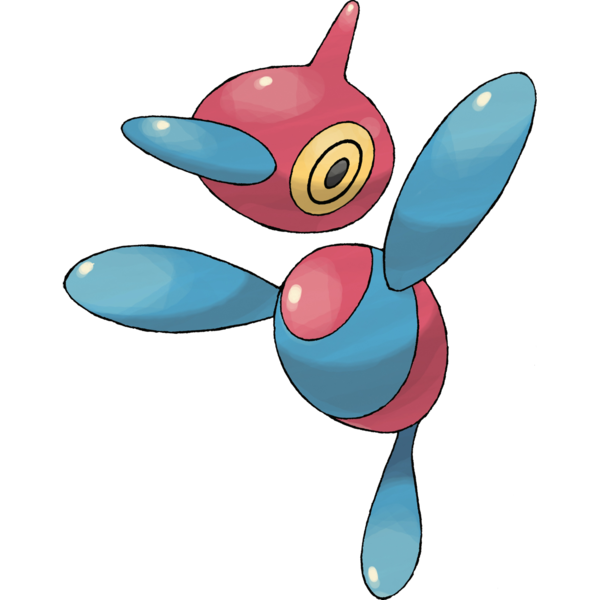
Ironically, one of the most bizarre intelligent forces in this setting has the most human origin of all. Doctor Kern loses her humanity pretty quickly into her story, both by cold-hearted choice and to her horror and woe depending on which facets of her we're talking about, leaving only the simulated memories of a dead woman puppeting a satellite that can gather just about anything but precious visual data. Over many centuries of scanning activity on the planet below, she comes to think and act a little more like a supernatural entity than anything else, and once she finally makes direct contact with what she still presumes to be her dearly beloved and adorable monkeys, she gets a little too hooked on the high of being regarded as a benevolent deity. I will say that once she learns the truth about her "children," it leads into ultimately one of the most heartwarming passages I've ever read in any science fiction novel, almost uncharacteristically touching from an otherwise charmingly arrogant mad scientist. Yes, she accepts her "children" for what they are, and yes, adapts pretty fast to being the Space Goddess of Spider Planet.
...At least until, inevitably, the rapid scientific enlightenment of her creation catches up with the creator. As Portiid civilization matures, the nature of their "goddess" is demystefied, piece by piece, until she's seen as something between a convenient asset and a nagging mom. By that point in time, the spiders have also perfected their own highly sophisticated computer technology powered not by electrical circuitry, but by modified colonies of ants, and yes, those ants are compatible with man-made binary code, allowing their former goddess-turned-ai-assistant to be downloaded to ants.
As revealed in the second and third books, that still isn't Kern's final incarnation, either, and her now enormous, ancient mind eventually takes her own special, widespread place as part of our growing, multi-species intergalactic society.
#1: The Corvids
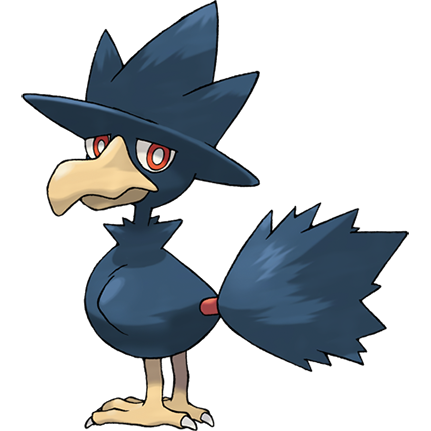
I know what you're thinking. After all that, birds? I'm putting really smart birds as the #1 strangest intelligence from the first three books?
The complete history of the Corvids doesn't get the same epic focus as the other "races," no. They're just passingly mentioned at the end of book two, and in book three, they're side characters whose origins are recounted as secondary information. Introduced to a nearly uninhabitable planet by a stranded and struggling Earth colony, they're just about the only life that successfully adapts to a near-global field of mutagenic radiation and far outlive the unsuccessful hominids. Centuries upon centuries later, they're renowned across our new galactic empire for the genious of their problem-solving skills and are a an indispensable asset to any interstellar exploration crew to host a bonded pair.
It sounds simple enough, except...they're not really sapient. Or, maybe they are. Or, maybe just not individually. Or...maybe yes? No? Both? Neither?!?
See, the corvids come in two distinct types. They look identical, but one type is strictly analytical and logical with no imagination, and the other type is boundlessly creative with no sense of purpose or reason. A single specimen, or even a whole flock of the same type, is still only as clever as our modern, unmodified corvidae, which as you know is certainly impressive for a bird but not "inventing new forms of interstellar travel" smart. It's only when you get one of each together, in a pair, that they begin to function like two complementary halves of the same brain, both rational and inventive enough to exceed even the greatest thinkers and inventors of human history.
This isn't even all that far-fetched. "You" are already only the result of constant communication between different areas of your brain, and most non-mammalian tetrapods, birds included, can already be thought of as "dual brained" thanks to their lack of the corpus callosum. One study found that birds can store two different sets of memories depending on which eye they're seeing through, which is why they tend to rapidly turn their heads and examine everything new from all the angles that they can if they want to maintain a single, seamless continuity. Brains are weird! This whole series is pretty much about how weird they are!
So maybe that still doesn't sound so strange, certainly not as strange as being downloaded to ants or anything, but here's where the corvids toe the line between "alien" and downright maddening, because if you ask them whether or not they're intelligent beings...they might look you right in the eye and say no. The pair most prominently featured in that third book, Children of Memory, spend a great deal of time debating with one another over whether or not they are sentient, and simply cannot seem to reach a satisfactory conclusion. This, too, isn't terribly far-fetched, considering that we now have chat bots capable of carrying on a conversation almost as convincingly, and those are still just algorithmic patterns drawing from a storehouse of data to construct a believable response.
...Which...is obviously also something our brains do, too. An adaptive data-retrieval process isn't a "sentience" all by itself, just as your emotions aren't all sentiences by themselves, but it's certainly a key part to a sentience. So obviously, possessing all these same faculties together should mean that the corvids are as sapient as we are, right? But...they'd still apparently debate you on that, just as they debate it amongst themselves over the course of the book. The more imaginative bird frustrates and teases its more logical counterpart with endless hypotheses and conundrums on the nature of their own awareness for hours at a time, like rival philosophers straight out of Ancient Greece, yet they still seem to conclude that they're not truly "intelligent" in a meaningful sense. They argue, with themselves, that they aren't thinking beings at all, and are merely simulations of thought running on organic hardware.
But, in the end, it kind of doesn't matter, because the same two birds are eventually pretty sure that's all anybody is.
If you liked all that, it's still only a teensy, tiny microcosm of the amazing books written by Tchaikovsky thus far, which range from hard science fiction to surreal magical fantasy and everything between. You can follow the author yourself here on bluesky.