Written by Jonathan Wojcik
Tapetails, bignoses and whalefish are three creatures so unlike one another that they were once classified
as three completely different families, though only sexless, juvenile tapetails, male bignoses
and female whalefish had ever been observed. As it's not unusual to know a deep-sea
animal from only one sex or one life cycle stage, it took until 2009 for us to discover tapetails
in the process of becoming either bignoses or whalefish, turning three mysteries into one
answer. All three are now properly classified under the whalefish's original family name,
Cetomimidae.
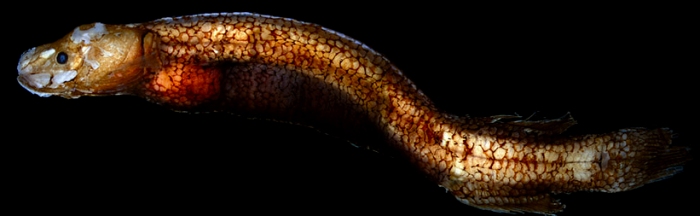
Photo by Dave Johnson
As it matures into a bignose, once classified as Megalomycteridae, a male tapetail will lose
its stomach and esophagus while its mouth fuses shut. Devoting all of its energy to mating, it
will live off stored copepod remains for the rest of its short life, using its huge nasal cavities
to track down the scent of a female.
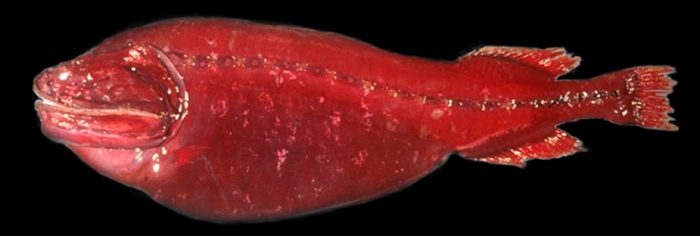
Photo by Kunio Amaoka
If our little tapetail was female, it matures into a whalefish, family Cetomimidae, which
appropriately enough engulfed the other two families once their nature was revealed.
Contrasting the males, these hungry beasties are mostly mouth and stomach, gobbling up
every other creature they can fit inside their elastic gullets. Some species even employ
their gills like additional mouth openings, slurping up small prey in three directions.

|

|

|
|
|
|
|